
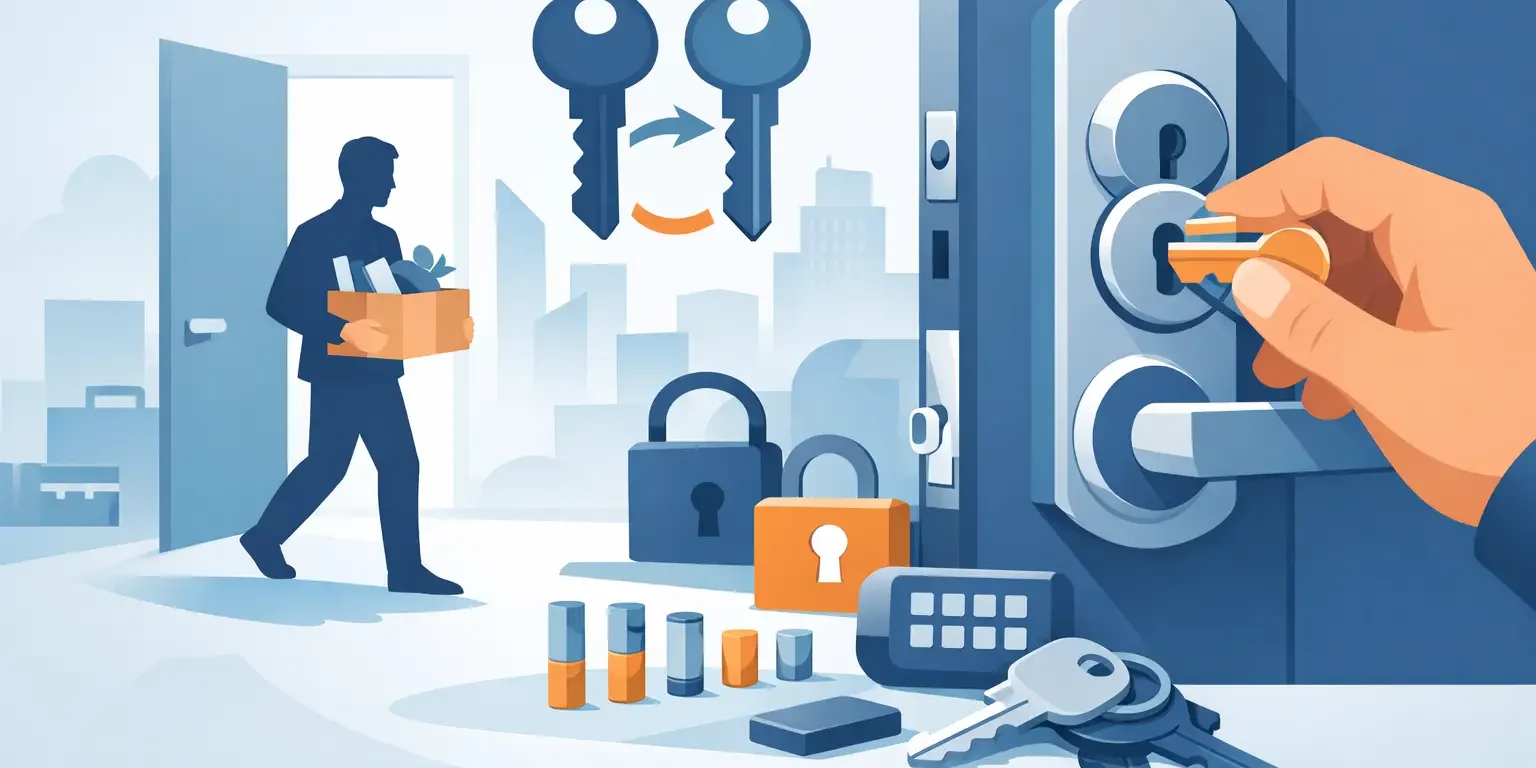
A staff departure can create a security gap faster than most business owners expect. If someone leaves with a key, a copied key, or access you can no longer account for, business rekeying after employee exit becomes a practical next step, not an overreaction. For offices, retail stores, warehouses, clinics, and multi-tenant commercial spaces, the question is usually not whether to act, but how quickly and how broadly.
When a former employee had access to your building, back office, storage room, or restricted interior doors, your locks may still work exactly as designed while your security no longer does. That is the problem rekeying solves. It changes the internal pins of the lock so old keys stop working, while allowing you to keep the existing hardware if it is still in good shape.
Why business rekeying after employee exit matters
A business key is rarely just a key. It may open your front door, your cash room, file storage, supply closets, side entrances, or shared tenant areas. In some workplaces, one employee key also opens gates, padlocks, cabinets, and secondary access points that were added over time without a full access plan.
That is why employee turnover deserves a security response that matches the level of access involved. If a former employee left on good terms and returned every key, your risk may be lower. If the separation was sudden, keys were not returned, or you are not sure whether duplicates exist, the risk changes immediately. Rekeying is often the fastest and most cost-effective way to restore control.
This is especially true for small and mid-sized businesses that do not use fully managed electronic access systems. Many local businesses in Ballwin and the greater St. Louis area still rely on standard commercial cylinders, deadbolts, lever locks, storeroom functions, and master key systems for offices. Those setups are dependable, but they only stay secure when key control is current.
Rekey or replace the locks?
Not every employee exit calls for full lock replacement. In many cases, rekeying is the better move because it solves the key access problem without forcing you to buy all new hardware.
Rekeying makes sense when the existing lock is in good working order, the brand and cylinder type are serviceable, and your main concern is stopping old keys from working. It is usually faster, less disruptive, and more affordable than replacing every lock on the property.
Replacement makes more sense when the lock is damaged, outdated, loose, poorly aligned, or no longer matches your security needs. It can also be the right choice if you want to move from basic hardware to restricted keyways, commercial-grade deadbolts, keypad locks, or a better master key layout.
For many businesses, the answer is a combination. Rekey the solid hardware that still performs well, and replace the weak points that have been causing trouble anyway. That approach keeps costs under control while improving security where it matters most.
What to assess right after an employee leaves
Before scheduling service, it helps to think through the full access picture. The exterior doors are the obvious place to start, but they are not always the only concern. A former employee may also have had access to interior offices, inventory rooms, utility areas, mailbox locks, gate locks, or commercial cabinets.
You should also consider whether that employee was ever issued a master key, a sub-master, or a key that worked across multiple suites or departments. If so, the scope of rekeying may be larger than expected. One lost or unreturned master key can affect a whole building layout.
Then there is the duplicate key issue. Even when a key is returned, many businesses cannot confirm whether copies were made over the years. If no strict key-tracking system was in place, rekeying provides certainty. That peace of mind matters when you are protecting customer records, expensive equipment, medication storage, tools, or after-hours access.
Business rekeying after employee exit in real-world situations
Different types of businesses face different decisions. A retail shop may need to rekey the front entrance, stockroom, office, and cash handling area. A property management office may need to address file storage, maintenance closets, and unit access policies. A warehouse may have multiple roll-up door entry points, cage locks, and supervisor-only areas.
Medical and professional offices often have a stronger need for controlled access because of records, prescription storage, and privacy requirements. Restaurants may need to review both customer-facing entrances and service entries, including liquor storage and office space. In each case, the right response depends on what the employee could access, how the departure happened, and whether keys were ever tightly controlled.
That is why a quick walkthrough with a locksmith can save time. It helps identify which doors should be rekeyed now, which hardware should be upgraded, and whether your current system still makes sense for daily operations.
How the rekeying process usually works
For most commercial properties, rekeying is done on-site. A technician inspects the locks, confirms brand compatibility, removes the cylinder or core, and changes the internal pin configuration so the old key no longer works. New keys are then cut to match the updated lock.
If your business uses a master key system, the work may be more involved. The locksmith needs to preserve the hierarchy of access or redesign it if the existing structure no longer fits. That can include setting separate keys for employees, manager-level access for certain doors, and a master key for ownership or authorized leadership.
The time required depends on the number of locks, how accessible they are, and whether the hardware is standard, worn, restricted, or part of a more complex commercial setup. A simple office suite may be straightforward. A larger facility with mixed hardware and multiple user levels takes more planning.
Signs your business should act immediately
Some situations leave very little room for delay. If keys were not returned, if the employee was terminated rather than resigning, or if there was any conflict around the departure, same-day service is worth considering. The same goes for cases involving theft concerns, sensitive records, cash access, or alarm codes that may still be active.
Urgency also goes up when multiple people shared keys informally. That often happens in growing businesses where convenience wins over process. Over time, no one is fully sure who has access to what. Rekeying gives you a clean reset.
Even if the exit was routine, waiting too long can create a bigger problem. Security decisions tend to get pushed aside once the staffing issue is over, but the exposure remains. If a business would never knowingly hand a former employee a current key, it should not leave old access in place by default.
A chance to improve key control
Rekeying should not be treated as a one-time fix with no follow-up. It is also a good moment to tighten procedures. Many businesses discover during turnover that they never had a clear key log, issue process, or return checklist.
A better system does not need to be complicated. Track who has each key, limit duplication where possible, separate employee access by role, and avoid giving one key more reach than necessary. If your business has grown, this may also be the right time to revisit whether a master key system still supports the way your team works.
Some companies may benefit from moving certain doors to keypad or electronic access, especially where turnover is frequent. That does not mean every lock needs to become high-tech. In many cases, a mixed setup works best, with dependable mechanical hardware on some doors and electronic control on the doors that need faster credential changes.
Cost, downtime, and what businesses can expect
Cost depends on the number of locks, the hardware type, and whether you are rekeying standard cylinders, master key systems, or restricted commercial hardware. Rekeying is often less expensive than replacing quality locks, but pricing can rise when the system is large or inconsistent.
Downtime is usually manageable. A mobile locksmith can often complete the work with minimal disruption, especially when the scope is clear before arrival. For businesses that need to stay open, service can sometimes be staged so priority doors are handled first and operations continue with limited interruption.
The best results usually come from acting before a security concern becomes an emergency. A planned rekey after an employee exit is simpler than dealing with a break-in, missing inventory, or an internal access problem later.
For local businesses, responsive mobile service matters because security issues rarely happen at a convenient time. A company like Locks R Us can come to your site, evaluate the hardware you already have, and help you decide whether rekeying, replacement, or a wider access update makes the most sense.
If an employee has left and you are unsure who still has working keys, trust that instinct and address it. Good business security is not about assuming the worst. It is about closing easy gaps before they turn into expensive ones.